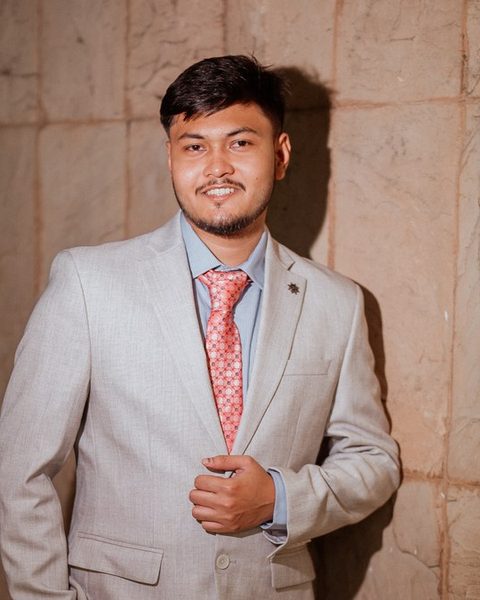
Foyshal Sarkar

AI Engineer · Full-Stack Developer

A. K. M Foyshal Sarkar

I build LLM and machine-learning systems in Python, and full-stack web products that people use.

B.Sc. Computer Science and Engineering, BRAC University (2026) · Dhaka, Bangladesh

Open to AI/ML and software engineering roles, in Dhaka or remote

Portrait of A. K. M Foyshal Sarkar
Live client productBooking and workshop system for a Dhaka repair shop. Next.js, PostgreSQL.
Measured RAG systemHeld-out evaluation: intent accuracy 78% → 96%, fact recall 91% → 99%. Docker and CI.
Thesis, team of 4Graph-conditioned attention for brain fMRI: 97.67% on HCP, 3 seeds.

Selected work

Things I have built and can walk you through

Client projectFull-stack · Sep 2026

Repair By Engineer: booking, tracking and workshop console

A live system for an earbud and headphone repair shop in Dhaka. Customers book and track repairs online; staff run jobs, payments and printed invoices from a phone-friendly console with admin and engineer roles.

  • 10-table PostgreSQL schema
  • Server-side role checks
  • Audit log
  • Migrated the shop's existing records

Next.js 16 · Auth.js · PostgreSQL · Tailwind CSS · Vercel

LLM / RAGPython · Sep 2026

Phone Advisor: local RAG and multi-agent system

Question answering and review writing over scraped phone specifications, running entirely on local open-source models; built in about three days as a take-home assessment. Questions are routed by intent first, so rankings come from SQL and lookups from filtered vector search.

  • Intent accuracy 78% → 96% (held-out)
  • 188-question eval set
  • Docker + CI

Python · FastAPI · FAISS · sentence-transformers · Qwen2.5-1.5B · CrewAI · SQLAlchemy

ResearchB.Sc. thesis · 2025–26

GC-JEPA: graph-conditioned attention for task-fMRI

A transformer whose attention is biased by each subject's functional brain connectivity, trained supervised and with self-supervised pretraining, to recognise which of 7 cognitive tasks a person was doing.

  • 97.67 ± 0.08% test accuracy
  • 7,443 brain graphs
  • 3 seeds, three-way ablation

PyTorch · Transformers · Self-supervised learning · Team of 4, BRAC University

More projects

Smaller and team work

  • Jul–Sep 2026Buildora: WebRTC voice calling (contributor)Built one-to-one calling for a university team's construction platform: authenticated Socket.IO signaling, a call-state machine and call history. TypeScript, Express, MongoDB. Pull request
  • Fall 2025Question topic classification (NLP)Compared 18 classifiers on 153k questions across 10 topics, from TF-IDF logistic regression to bidirectional GRU/LSTM; best macro-F1 0.666 on 60k held-out questions. Code
  • Jan 2026Brain tumor MRI: multimodal fusion (team of 3)ViT embeddings fused with metadata and mask features reached 87.4% test accuracy, almost entirely from the image stream. We traced why the other streams added nothing to how the data was paired, and documented it. Code
  • Spring 2025Systems programming in CA Unix shell with pipes, redirection, ; and &&, history and signal handling (code), and, with a team, vsfsck, a file-system consistency checker tested against 14 generated corrupted images (code). Both have CI.
  • 2025Course team projectsA 3D arena game in PyOpenGL (team of 3) and an ESP32/Arduino home-security system with RFID, flame and motion sensors (team of 5).

Research

Brain networks inside the attention mechanism

For our B.Sc. thesis, four of us asked a simple question: if we already know which brain regions tend to activate together, can a transformer use that map directly when it decides what to attend to?

Attention = softmax(QKᵀ / √d + α · G) · V

G is the subject's functional-connectivity matrix (Pearson correlation between 400 brain regions) and α is one learnable number per layer, so the model decides how much to rely on it.

HCP task-fMRI, 7 classes, mean ± std over 3 seeds
ModelTrainingTest accuracy
Graph-conditioned transformerSupervised97.67 ± 0.08%
GC-JEPASelf-supervised pretraining, then fine-tuning96.73 ± 0.17%
JEPA-style baseline (no graph bias)Self-supervised pretraining, then fine-tuning96.06 ± 0.35%
Reference: SpectralBrainGNNBest reported on the NeuroGraph HCP-Task benchmark (arXiv, 2025)96.25%

The reference number is taken from its paper, not re-run on our split. A different protocol (GCN + NetMF, 360-region atlas) has reported 97.70%. Method, ablations and limitations

Experience and education

Background

  • Sep 2026Freelance Full-Stack Developer, Repair By Engineer (Dhaka)Designed, built and deployed the shop's website and staff console.
  • Jul–Sep 2026Contributor, Buildora (university team project)WebRTC voice calling; pair-programmed on the LLM assistant, rain alerts and map integrations.
  • Oct 2025–Jun 2026B.Sc. thesis, team of 4Graph-conditioned attention for task-fMRI. My part: the attention-bias integration, region-relationship analysis, hyperparameter tuning, fine-tuning and the LaTeX thesis. Supervisor: Prof. Chowdhury Mofizur Rahman, BRAC University.
  • 2022–2026B.Sc. in Computer Science and Engineering, BRAC UniversityCGPA 3.71 / 4.00 · University Merit List Scholarship · completed September 2026

Skills

What I work with

Machine learning

Python, PyTorch, TensorFlow/Keras, scikit-learn, Hugging Face Transformers, sentence-transformers, FAISS, RAG, CrewAI

Backend and data

FastAPI, Node.js, Express, REST APIs, Socket.IO, WebRTC, PostgreSQL, MySQL, MongoDB, SQLAlchemy, Auth.js

Frontend and tools

TypeScript, React, Next.js, Tailwind CSS, Git, GitHub, Vercel, Jupyter; also PHP/Laravel, C/C++, ESP32

Contact

Let's talk

I am looking for AI/ML engineering, software engineering and research assistant roles. Email is the fastest way to reach me.